
posted 19th April 2026
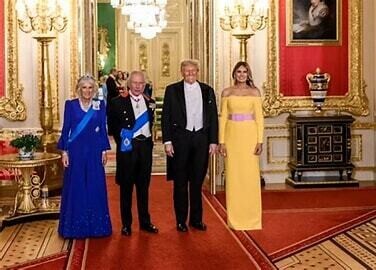
Two hundred and fifty years ago this July, America declared their independence from the British monarchy. At the end of the month (April 2026), they will be welcoming back George III’s successor, King Charles III - as a visitor. But should he be going?
What is a state visit?
In a state visit, the head of state of one country formally entertains the head of state of another. It involves a forest of flags, several wardrobes full of uniforms, processions here there and everywhere, the national anthems of both countries on repeat (lots of standing to attention), all culminating in a ten course banquet in the most spectacular setting the host can provide, topped off with speeches by the respective heads of state saying … not very much. State visits rarely deal with issues of substance. They are not occasions for hard negotiations on trade deals or defence pacts. That happens when heads of government meet. (See this post for the difference between a head of state and a head of government.)
What is the point of state visits?
State visits are above all an exercise in soft power. They are a symbolic representation of the relationship between two countries. Symbols matter, because how a country is perceived changes how it is treated. A successful state visit can pave the way to more effective collaboration between two countries on issues like trade, diplomacy, defence etc.
Why is the king going, not the prime minister?
Under the British constitution, the monarch (currently King Charles) is the head of state, and the prime minister (currently Keir Starmer) is the head of government. In theory, the king appoints the prime minister, is commander-in-chief of the armed forces and signs off on all laws. In practice, the king appoints as prime minister whoever the British people have chosen in an election, and then follows the advice of that prime minister and their government in all matters. So the king has not chosen to go to the US; the government have chosen to send him there. The king represents the whole nation, not just the party which happens to be in power at the moment.
Should we cancel the king’s state visit?
For
Principled
A state visit will give a seal of approval to Donald Trump and his policies. To take just his greatest hits: he has imposed brutal tariffs on international trade, pushing up prices around the world; threatened to invade Greenland, a territory of Denmark; indicated that he might abandon NATO, leaving European countries defenceless; cosied up to Vladimir Putin, enabling his invasion of Ukraine; and started an illegal, unnecessary, unwinnable war with Iran which has cost thousands of lives and forced up oil prices, thereby sending the world economy spiralling into recession. Not to mention thinking he’s Jesus.
Trump will use the king’s state visit to make himself look respected and respectable. He should not be the first, and is not the second. Britain should take a stand against his policies by cancelling the visit.
Pragmatic
Trump is a bully, who only respects force. Attempting to appease him with a state visit will not work. He will take what he wants from the occasion, and give nothing back. Keir Starmer has already tried flattery, inviting him to the UK for a state visit with a handwritten letter from the king; he was rewarded by being insulted when he refused to join the US’s attack on Iran. Countries that stand up to Trump are more likely to get what they want from him. He respects strength, and despises weakness. Sending the king to make small talk over canapes in the hope that Trump will be nice to us looks like weakness.
Against
Principled
State visits are not about the individuals involved; they are about the countries. Britain and America have had an important relationship for many, many years, one that existed before President Trump and King Charles, and will exist long after both men are gone. The state visit is about that relationship. The president and the king are simply the current representatives of those countries. As they say in the army, you salute the uniform, not the person.
It is particularly important to have this visit in 2026, as it marks 250 years since the American declaration of independence in 1776. This was the founding document of the first democracy of the modern age. George III was no democrat; his successor Charles III, as a constitutional monarch, now upholds and protects British democracy. A royal visit in this historic year will help celebrate and reinforce the fundamental values of democracy. It might even encourage Mr Trump to stop behaving like a king.
Pragmatic
The monarchy is a unique asset for Britain, and we should use it in the national interest. President Trump has a weakness for the royal family. In his mind, he derives a great deal of status from being associated with them. King Charles is one of the few national leaders he has not (yet) insulted. If a couple of parades and one or two obsequious speeches bring Britain a better trade deal, that is a small price to pay.
President Trump is not only susceptible to flattery. He is also thin-skinned and vindictive. If we cancelled the state visit at such short notice, he would undoubtedly lash out against Britain with retaliatory tariffs or other measures.
Motion that goes with this topic
This house would cancel the king's visit to the US.